
If you engage with acne nutrition, you quickly notice: it is not just about individual foods. Your body responds to interactions. Your gut, hormones, inflammation, and your metabolism are interconnected. This is exactly where this recipe comes in. It is not designed to be perfect. It creates conditions in which your body can function in a stable way.
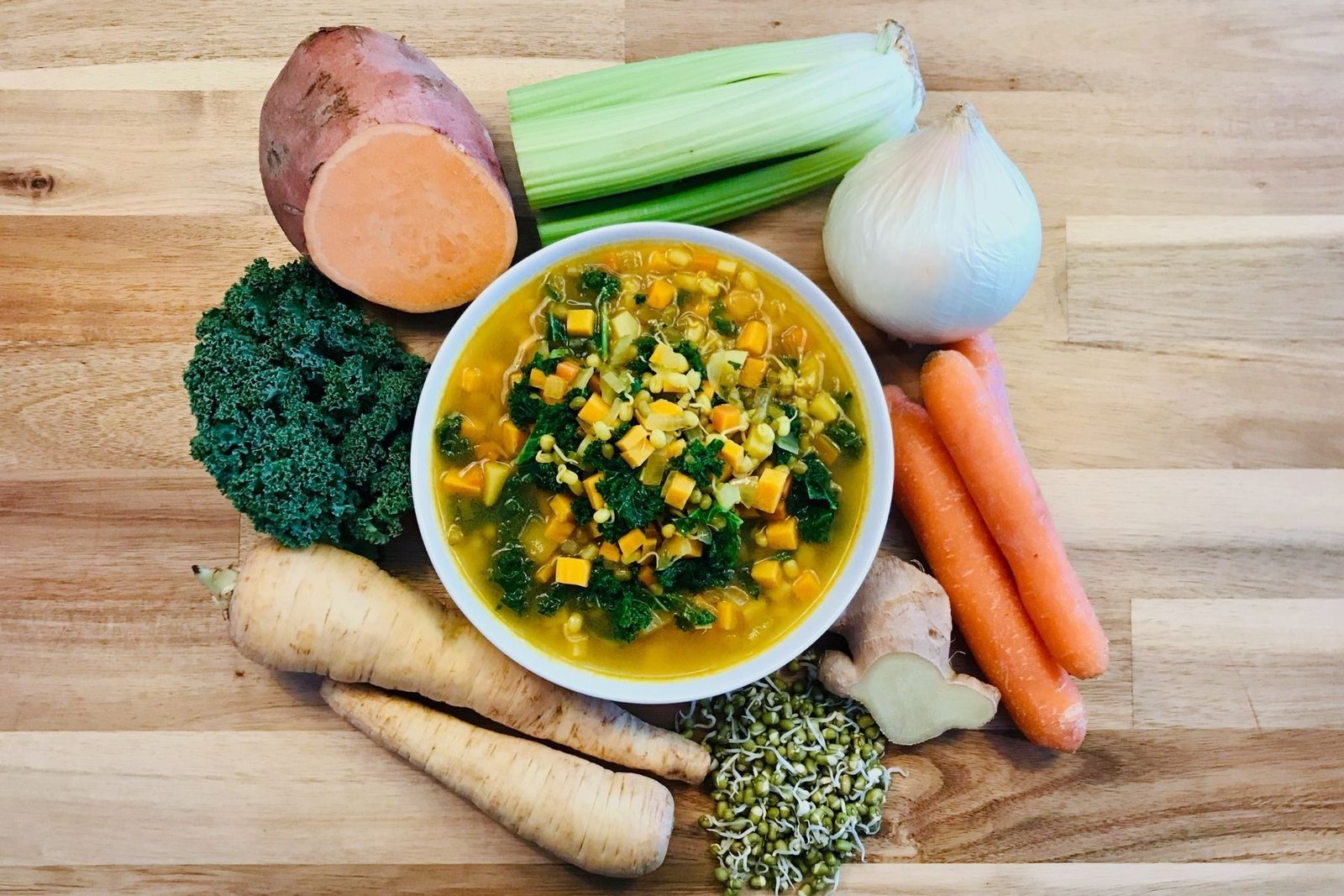
This colorful vegetable stew with mung beans combines carefully selected ingredients that support your digestion while providing a high nutrient density. It is not about restriction, but about a balance of tolerance, diversity, and function.
Why mung beans are often better tolerated
Legumes play a special role in acne nutrition. They provide fiber, plant-based protein, and complex carbohydrates. This combination helps keep your blood sugar stable. This is relevant because strong fluctuations in blood sugar can influence hormonal processes, which in turn can promote inflammatory skin reactions.
Mung beans occupy a unique position. They are considered particularly easy to digest and tend to cause fewer symptoms compared to other legumes. This is partly due to their composition and the fact that they contain fewer difficult-to-digest fiber components.
In this recipe, the mung beans are also sprouted. During the sprouting process, their composition changes. Certain antinutrients are broken down, and nutrients become more available to your body. At the same time, digestion is further supported. Your gut has to compensate less and can work more efficiently.
Especially if your gut is sensitive, this difference can be decisive. A stable digestion is one of the central prerequisites for stable skin.
Fiber as the link between gut and skin
This stew provides fiber from multiple sources: mung beans, sweet potatoes, carrots, parsnips, and kale. This diversity is crucial. Your gut microbiome does not thrive on a single nutrient, but on diversity.
Fiber is fermented by bacteria in the large intestine. This process produces short-chain fatty acids that nourish your intestinal lining and have inflammation-regulating effects. When this process functions well, its effects are not limited to the gut. Inflammatory processes throughout your body can shift — and with them, your skin.
An imbalanced gut, on the other hand, can lead to reduced nutrient absorption, increased inflammatory signaling, and altered hormonal processes.
Root vegetables: stable energy without irritation
A large part of this dish consists of root vegetables. Sweet potatoes, carrots, and parsnips provide complex carbohydrates that help stabilize your energy levels. At the same time, they contain micronutrients that are relevant for skin processes.
Sweet potatoes provide, among other things, magnesium. This mineral is involved in numerous enzymatic processes, including those related to stress regulation and metabolism. Carrots contain beta-carotene, a precursor of vitamin A, which plays a role in skin renewal.
Parsnips and carrots are also mild and well tolerated. They do not unnecessarily irritate digestion and at the same time provide fiber. This combination is key: your body receives nutrients without being burdened at the same time.
The white onion complements this with its mild, slightly sweet flavor. It is often better tolerated than sharper varieties and integrates into an overall calm, well-tolerated flavor profile.
Mild spices instead of overstimulation
Spices are often underestimated in acne nutrition. Many hot spices can irritate digestion or the nervous system in sensitive individuals. This can indirectly affect your skin.
This recipe deliberately focuses on mild, digestion-supporting spices such as fennel seeds and caraway. They stimulate digestive juices and can reduce bloating.
Fresh ginger adds a subtle heat without overwhelming the system. Its bioactive compounds are associated in research with antimicrobial and inflammation-modulating effects. At the same time, it supports digestion and gives the dish depth rather than heaviness.
Lemon juice and nutrient absorption
A seemingly small detail in this recipe is lemon juice. It influences not only the flavor but also the utilization of certain nutrients. Vitamin C can significantly improve the absorption of plant-based iron from legumes.
This is a good example of how nutrition does not consist of isolated components. It is not only about what you eat, but also about how foods interact with each other.
Kale as a fresh finish
At the end, kale is added and only briefly cooked. This helps preserve sensitive nutrients. Kale provides a high density of vitamins and phytochemicals that can have antioxidant effects.
Antioxidants play a role in how your body handles oxidative stress. This is associated in research with inflammatory processes that are also relevant in acne.
What this recipe actually means for your skin
This vegetable stew is not a miracle cure. But it illustrates a principle that is often overlooked: skin-friendly nutrition does not arise from individual “superfoods,” but from the interaction of tolerance, nutrient density, and stable digestion.
You provide your body with fiber for your microbiome, complex carbohydrates for stable blood sugar, micronutrients for metabolic processes, and at the same time as few irritants as possible. This combination can make a difference over time.
As you begin to understand these connections, your perspective on nutrition changes. You no longer react only to symptoms, but start to recognize patterns.
And this is where it becomes interesting: nutrition and acne are far more complex than they appear at first glance. Your gut, hormones, inflammation, and individual intolerances are interconnected and cannot be viewed in isolation. The E-Book explores exactly this: which mechanisms truly matter, how to structure and adapt your nutrition, and why many approaches do not work long term. This is the point where real understanding begins to shift something.
Veggie Stew with Mung Beans

Equipment
- 1 vegetable peeler
- 1 Vegetable grater
- 1 Cutting board and knife
- 1 Cooking pot and spoon
- 1 Citrus press
Ingredients
- 75 g organic mung beans dried
- 300 g sweet potatoes
- 100 g carrots
- 100 g onion snow-white
- 100 g parsnips
- 30 g celery sticks
- 1 tbsp coconut oil native
- 2 tsp fennel seeds ground
- 2 tsp real caraway ground
- 4 tsp ayurvedic spice blend see basic recipe
- 10 g ginger fresh
- 1 liter water
- 4 tbsp lemon juice freshly squeezed
- 1 tbsp salt
- 50 g kale
Instructions
- Germinate 75 g organic mung beans according to the instructions in the basic recipe. Alternatively, the mung beans can also just be soaked and then processed.
- Wash, peel and dice 300 g sweet potatoes, 100 g carrots, 100 g onion, 100 g parsnips and 30 g celery sticks. Finely grate 10 g ginger.
- Heat 1 tbsp coconut oil oil in a saucepan and add vegetables and 2 tsp fennel seeds, 2 tsp real caraway and 4 tsp ayurvedic spice blend. Fry everything briefly.
- Add 1 liter water, 1 tbsp salt, 4 tbsp lemon juice and mung beans and bring to a boil. Reduce heat and simmer for 20 minutes until vegetables are tender.
- Clean and finely chop the 50 g kale. Add the kale to the stew for the last few minutes and cook until the kale has wilted but is still bright green.

