
The desire for something crunchy is not a problem. What matters is what you give your body in that moment. Conventional chips mainly provide highly processed fats, oxidized oils, and additives that can trigger processes in the body that extend far beyond the moment itself. Especially in the context of acne, this plays a larger role than is often assumed.
Kale chips address exactly this point. They are easy to make, consist of only a few ingredients, and at the same time provide a high nutrient density. This changes not only the snack itself, but also the effect that this snack has within your body.
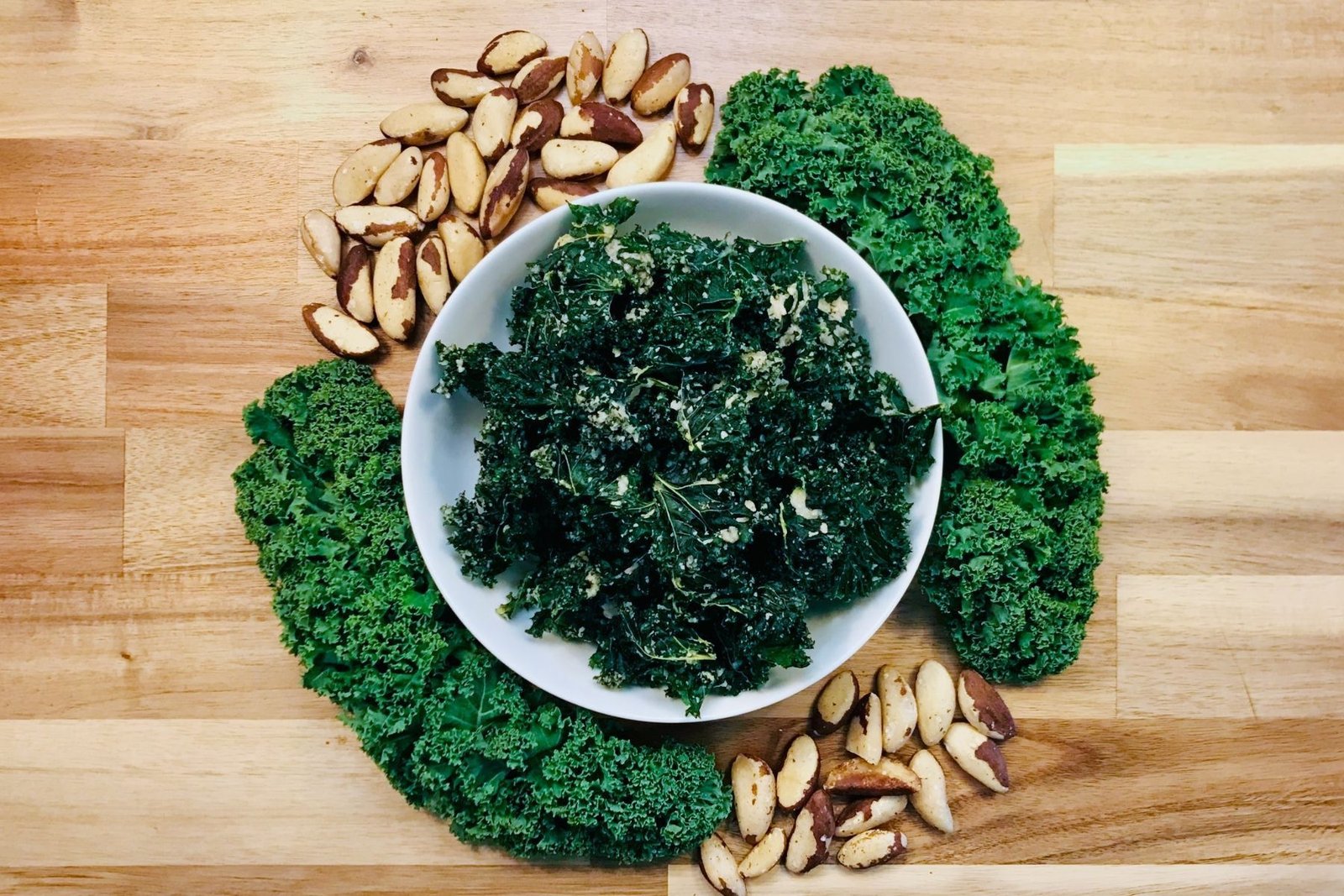
Why conventional chips can affect your skin
Many processed snacks contain large amounts of repeatedly heated vegetable oils. These fats can promote oxidative stress in the body. Oxidative stress means that free radicals are formed, which can attack cellular structures and intensify inflammatory processes.
At the same time, such foods often affect your blood sugar. Rapid increases in blood sugar directly influence insulin. Insulin, in turn, intervenes in hormonal regulatory systems that are linked to sebum production and inflammation. This is exactly where an interface between nutrition and skin emerges.
This does not mean that a single snack causes acne. However, repeated impulses of this kind can amplify processes that are already active in the background.
Kale chips as a skin-friendly snack
Kale chips work differently. They consist of a leafy green vegetable that is among the most nutrient-dense foods available, combined with a few carefully selected ingredients. Instead of empty calories, your body receives substances that actively intervene in metabolic processes.
This is especially relevant within the context of an acne nutrition approach. It is not just about reducing problematic foods. It is about deliberately providing your body with building blocks that can regulate inflammation, support the gut, and promote hormonal balance.
What kale does in your body
Kale belongs to the cruciferous vegetable family. These vegetables contain secondary plant compounds such as glucosinolates. In the body, they are converted into bioactive compounds that are involved in detoxification processes.
These processes primarily take place in the liver. The liver is a central organ when it comes to breaking down hormones and eliminating metabolic byproducts. When it is supported, this can also indirectly influence your skin.
In addition, kale provides antioxidants. These act as counterparts to free radicals and can help reduce oxidative stress. This type of stress is repeatedly discussed in connection with inflammatory acne.
Another crucial point is preparation. When kale is consumed raw or gently dried, heat-sensitive plant compounds are largely preserved. This allows you to take in these substances in a form that can be particularly active within metabolism.
The role of gut, inflammation, and skin
Your gut determines how well your body can absorb nutrients. At the same time, it influences your immune system and hormonal processes. When the balance in the gut is disrupted, inflammation can develop, which can also manifest in the skin.
Certain plant compounds from vegetables such as kale reach the large intestine and are further processed there by bacteria. This produces metabolic byproducts that can support the intestinal lining and have anti-inflammatory effects.
This connection between gut and skin is well described. Changes in the microbiome can influence hormonal shifts, oxidative stress, and inflammatory processes.
A single snack cannot resolve this entire process. However, it can be part of a system that either burdens or supports your body.
Why Brazil nuts are more than just a source of fat
Brazil nuts provide healthy fatty acids and are a natural source of selenium. Selenium is a trace element involved in antioxidant defense systems. It supports enzymes that neutralize free radicals.
This protection plays a role particularly in inflammatory skin processes. At the same time, Brazil nuts are generally well tolerated and low in histamine, making them a suitable ingredient for many people.
Fats also play an important role in the absorption of fat-soluble vitamins. Without sufficient fat, your body cannot optimally utilize certain nutrients from kale.
Lemon juice and mineral absorption
Lemon juice does more than add flavor. The acidity it contains can support the absorption of certain minerals. At the same time, it provides vitamin C, which itself has antioxidant properties and is involved in many enzymatic processes.
Vitamin C also plays a role in collagen formation. Collagen is a structural protein of your skin. Even if this effect should not be viewed in isolation, it illustrates how closely nutrition and skin structure are connected.
Why simple ingredients are often the better choice
This recipe consists of only a few components. That is precisely its strength. Each ingredient fulfills a clear function in the body. There is no overload of stimuli, but rather a targeted input.
At a time when many products consist of long ingredient lists, this simplicity can make a difference. Your body has less to compensate for and can focus more on fundamental processes.
Alternative: savoy cabbage instead of kale
Kale is not available year-round. Savoy cabbage can be a practical alternative. It also belongs to the cabbage family and offers similar properties, even though the composition varies slightly.
What matters is not a single food, but the group. Cabbage vegetables provide a combination of fiber, secondary plant compounds, and micronutrients that work together.
Raw food and gentle processing
The idea of consuming foods as unprocessed as possible originates in part from raw vegan nutrition. It is not about extremes, but about a principle: absorbing nutrients in their most intact form.
A dehydrator makes this possible. At low temperatures, sensitive compounds are preserved. Alternatively, an oven at a low temperature also works. Even though some raw food quality is lost, the snack remains significantly more nutrient-dense than conventional chips.
Why children often like kale chips
The combination of a crunchy texture and a slightly nutty flavor makes this snack surprisingly accessible. Children, in particular, respond strongly to texture. When a food is crunchy, it is often intuitively accepted.
This shows that skin-friendly nutrition does not have to be complicated. It can fit into everyday life while still providing real value.
Conclusion: acne nutrition is more than individual foods
Kale chips are a good example of how simple foods can influence complex processes in the body. They provide antioxidants, support the gut, and create targeted impulses within metabolism. At the same time, they show that it is not about restriction, but about better alternatives.
This is where it becomes interesting: acne nutrition is not a linear system. Gut, hormones, inflammation, and individual intolerances interact. Many connections are not immediately visible. The e-book explores this in more depth, including which mechanisms are truly decisive, how to structure and individualize your nutrition, and which common mistakes often go unnoticed.
Kale Chips

Equipment
- 1 blender
- 1 Citrus press
- 1 Small pot
- 1 Salad bowl
- 1 Oven and baking sheet
- 1 Dehydrator (optional)
Ingredients
- 150 g kale (or savoy cabbage)
- 100 g brazil nuts
- 2 tbsp lemon juice freshly squeezed
- ½ tsp salt
Instructions
- Pick the kale, tear into bite-sized pieces, wash and shake dry.
- Wipe out the blender with a tea towel so that the inside of the blender jar is completely dry.
- Finely grind brazil nuts in a blender.
- In a small saucepan, knead the ground brazil nuts, lemon juice and salt into a mass.
- In a bowl, knead the nut butter with the kale so that the kale is evenly coated.
- If you have a food dehydrator, you can dehydrate the chips in it. Alternatively, you can use your oven: Line a baking rack with baking paper and spread the kale on it. Let the chips dry in the oven at 50? (122?) circulating air. Keep opening the oven to allow moisture to escape. The circulating air sign always includes a propeller and a dash or jagged line that symbolizes the heat. If the heat only comes from above, the drying process is gentler and slower. Depending on the oven, the drying process lasts from 45 minutes to 3 hours. Periodically check how dry the chips are and mix them up to dry the lower kale leaves as well.


Thanks for sharing. I read many of your blog posts, cool, your blog is very good. https://accounts.binance.info/hu/register-person?ref=IQY5TET4
Thanks for sharing. I read many of your blog posts, cool, your blog is very good. https://www.binance.info/register?ref=QCGZMHR6