
Many spice blends seem practical at first glance. One spoonful, and the food tastes intense. But this intensity is often created by substances your body does not recognize as natural food. Yeast extract, isolated flavorings, or flavor enhancers act directly on your nervous system and can amplify processes already running in the background: inflammation, irritation reactions, or hormonal fluctuations.
If your skin reacts sensitively, it is worth taking a closer look at these seemingly small details. What you consume daily in small amounts accumulates over time. This is exactly where a homemade, skin-friendly soup seasoning comes in: it reduces stimuli and brings you back to what your body can actually process.
Why store-bought seasonings can indirectly affect your skin
Acne is not caused by a single food. It develops from an interplay of gut, hormones, immune system, and inflammatory processes. This is often overlooked. Additives such as yeast extract can have indirect effects, for example by stimulating the nervous system and thereby amplifying stress responses. At the same time, highly processed ingredients can influence the balance in your gut.
Your gut is not only responsible for digestion. It determines how well your body can absorb nutrients, how strongly inflammatory processes occur, and how stable your immune system responds. If this system becomes imbalanced, it can also show up in your skin.
A simple, natural seasoning reduces exactly these disruptive factors. It provides flavor without introducing additional stimuli.
The foundation: what belongs in a skin-friendly soup seasoning
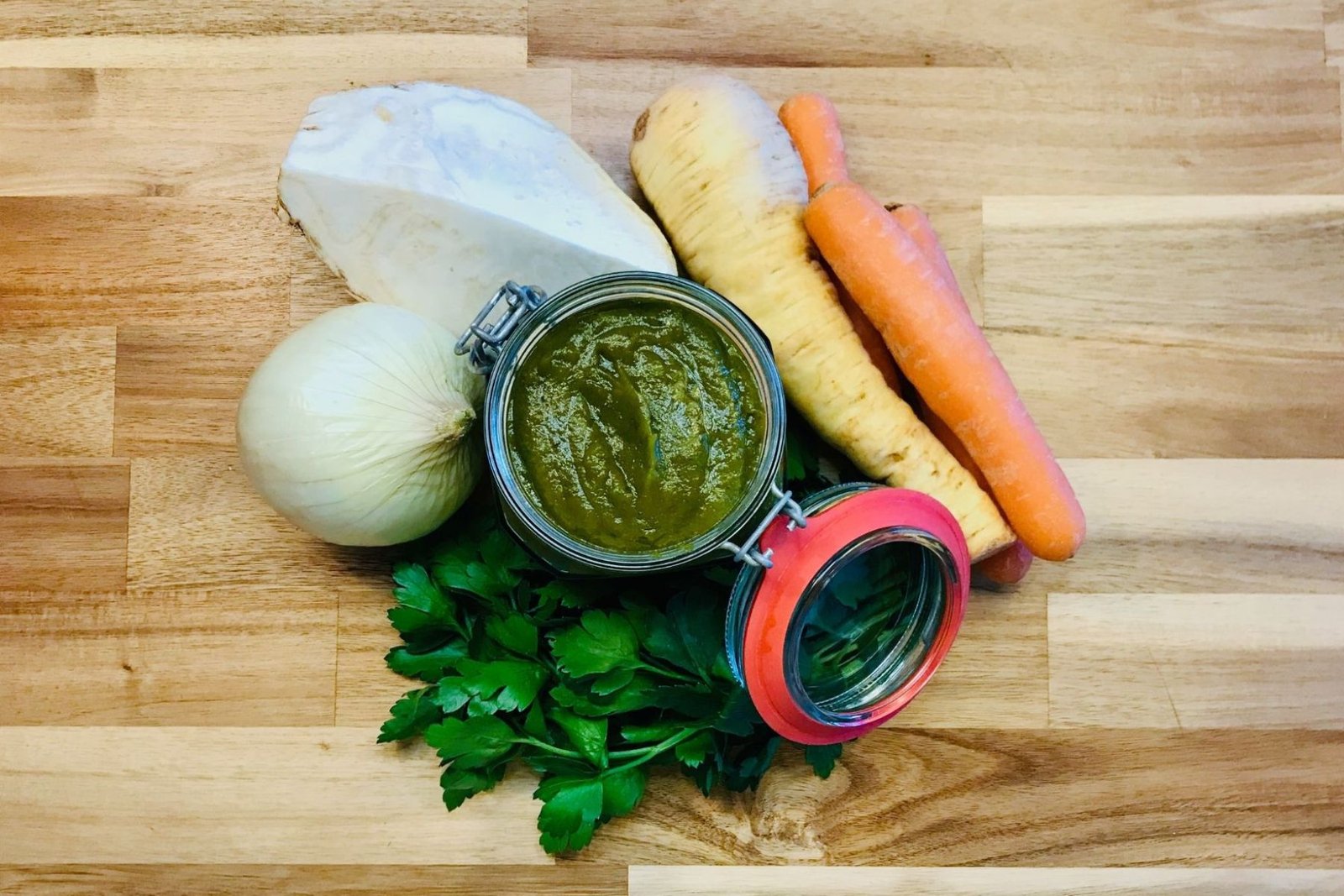
The composition is intentionally minimal. Carrots, white onions, celeriac, parsnips, fresh parsley, optionally lovage, and salt form the base. Nothing more is needed.
This combination is not random. It provides not only flavor, but also a specific nutrient structure that supports your body instead of overwhelming it.
Carrots: cell protection and skin renewal
Carrots provide beta-carotene, a precursor of vitamin A. This vitamin regulates the formation of new skin cells. It influences how quickly skin cells renew and how stable the skin barrier remains. At the same time, carotenoids act as antioxidants and protect cells from oxidative stress—a process that can intensify inflammatory skin changes.
In this way, carrots directly influence a central mechanism: the balance between cell regeneration and inflammation.
Onions: sulfur compounds and detoxification processes
Onions contain sulfur compounds that play a role in the body’s own detoxification processes. These processes mainly take place in the liver but are closely connected to your gut. When your body processes metabolic byproducts efficiently, it reduces the overall burden on your system.
This is not a direct “skin effect,” but a systemic connection. This is often where the difference emerges: skin does not improve in isolation, but as a result of internal balance.
Celeriac and parsnips: minerals and the gut environment
Celeriac and parsnips provide minerals such as potassium and magnesium, as well as fiber. Fiber is essential for your gut microbiome. It serves as nourishment for certain gut bacteria that produce short-chain fatty acids. These substances stabilize your gut barrier and help regulate inflammation.
If these processes are disrupted, your gut lining can become more permeable. The immune system reacts more strongly, inflammatory signaling pathways increase—and this can manifest in your skin.
Parsley and lovage: secondary plant compounds and antioxidant effects
Fresh herbs provide secondary plant compounds with antioxidant properties. This means they neutralize free radicals that damage cellular structures. Oxidative stress is a central factor in inflammatory skin processes.
At the same time, herbs add natural aroma without overstimulating your sensory system. This is a key difference compared to artificial flavorings.
Salt: function rather than problem
Salt is often viewed critically in a general sense. In this context, however, it serves a clear function. It preserves the mixture so that it can be stored for weeks and enhances the natural flavor of the ingredients.
The decisive factor is the quantity and quality. Salt is not used here to mask flavor, but to carry it.
Why this combination is more than just flavor
This soup seasoning does not act in isolation. It is part of a larger system. The nutrients it contains support your gut microbiome, provide antioxidant compounds, and contribute to the regulation of inflammatory processes.
This does not mean it “cures” acne. But it changes the conditions under which your body operates. And these conditions determine whether inflammation subsides or persists.
Your body does not respond to individual foods, but to patterns. A natural, low-stimulus foundation can shift this pattern over time.
A small change with a significant impact in everyday life
A homemade soup seasoning appears inconspicuous. It sits in your refrigerator, is used casually, and easily fades into the background. That is exactly where its strength lies. It accompanies you every day.
Each meal becomes a little simpler, clearer, and more tolerable. You reduce additives almost automatically while strengthening your nutrient base. This is not a short-term effect, but a structural change in your diet.
Why simple recipes are often the key lever
Many people try to completely overhaul their diet and get lost in complicated rules. Yet the greatest leverage often lies in the basics. A simple seasoning that you use daily has more impact than a single “perfect” recipe.
It creates a consistent foundation. And this consistency is what matters if you want to understand how your diet is connected to your skin.
In my e-book, I go much deeper into these connections. You will learn which mechanisms truly drive acne and why gut, hormones, inflammation, and individual intolerances interact. I also show you how to structure your nutrition and avoid common mistakes. Because skin health is not random—it is the result of many small, often invisible processes.
Soup Seasoning

Equipment
- vegetable peeler
- Cutting board and knife
- blender (optional with heating function)
- cooking pot (if your blender has no heating function)
Ingredients
- 200 g onion snow-white
- 200 g parsnips
- 200 g carrots
- 200 g celery root
- 50 g parsley fresh
- 50 g lovage fresh
- 200 g salt
Instructions
- Clean the vegetables and cut them into pieces. Wash and pluck the herbs.
- Blend all the ingredients in a blender until you get a thick paste.
- Let the mixture simmer for about 20 minutes until it forms a thick paste.
- Pour the paste into screw-top jars and store in the fridge.


I don’t think the title of your article matches the content lol. Just kidding, mainly because I had some doubts after reading the article.
Thanks for sharing. I read many of your blog posts, cool, your blog is very good. https://www.binance.com/register?ref=IXBIAFVY
Thanks for sharing. I read many of your blog posts, cool, your blog is very good. https://www.binance.com/bn/register?ref=WTOZ531Y
Your point of view caught my eye and was very interesting. Thanks. I have a question for you.