
Many people turn to fruit juices because they are considered healthy. At the same time, many report that these very juices worsen their skin. Impurities, redness, or an unsettled skin appearance often do not occur by chance. What matters is not whether a juice is “healthy,” but how your body reacts to its components.
Pomegranate grape juice stands out in this context. It consists of only two ingredients—dark red grapes and pomegranate—and provides an unusually high density of phytochemicals. These are precisely the compounds that interact with processes also involved in acne.
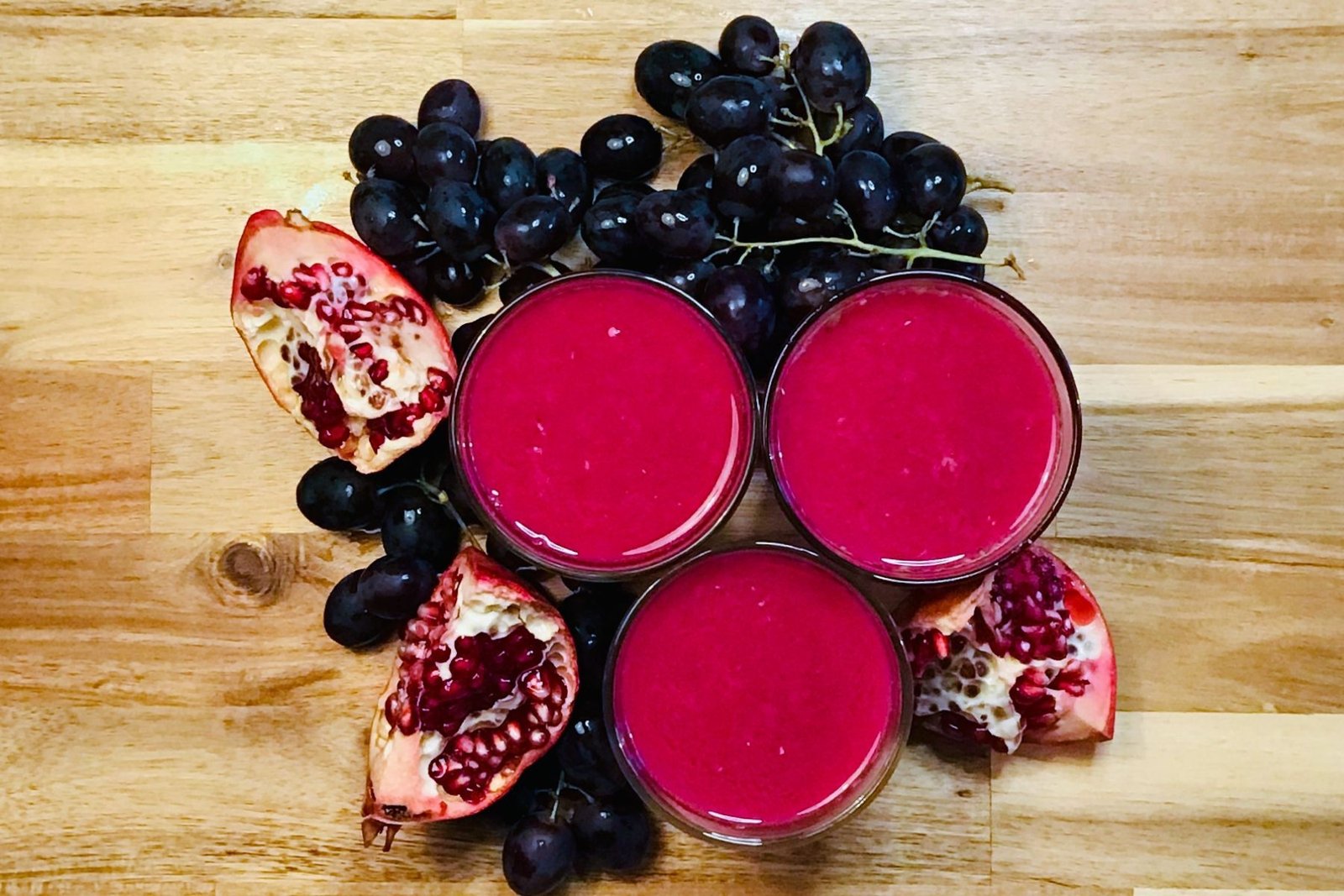
Why this juice differs from other fruit juices
Fruit juice is not the same as fruit juice. Many conventional juices contain not only sugar but also substances that can trigger reactions in your body. Especially with sensitive skin, this often shows up indirectly through inflammation or hormonal shifts.
Pomegranate and grapes, on the other hand, primarily provide polyphenols. These secondary plant compounds do not act directly on the surface of the skin but influence processes within your body. These include oxidative stress, inflammatory responses, and the stability of your blood vessels.
Oxidative stress occurs when free radicals predominate in your body. These reactive molecules can attack cellular structures and intensify inflammatory processes. This is where antioxidants come in, by buffering these reactions.
Pomegranate: polyphenols and inflammatory processes
Pomegranate contains a high concentration of polyphenols, particularly punicalagins and ellagic acid. These compounds act as strong antioxidants and interact with inflammatory signaling pathways.
Inflammation plays a central role in acne. Acne is not purely a skin condition but an inflammatory disorder involving multiple systems. When inflammatory processes in your body are elevated, this can directly show up in your skin.
The compounds in pomegranate cannot “stop” these processes, but they can influence the conditions under which inflammation develops or intensifies. This is a distinction that is often overlooked.
Grapes: resveratrol and vascular function
Dark red grapes provide, in addition to natural sugar structures, primarily resveratrol and flavonoids. These compounds affect your blood vessels and microcirculation.
Your skin depends heavily on circulation. Each cell is supplied with nutrients through very fine vessels. If this supply is impaired, it can show up as pale skin, delayed regeneration, or inflammatory processes.
Resveratrol is associated in research with antioxidant and inflammation-regulating properties. Among other things, it influences signaling pathways related to cellular stress and aging processes.
This creates an interaction: while pomegranate acts strongly on oxidative stress, grapes tend to support vascular function and the transport of nutrients.
Histamine and acne: an often overlooked factor
One aspect that is rarely discussed in connection with skin is histamine. Histamine is a signaling molecule in your body that is involved, among other things, in inflammatory reactions.
Certain foods contain histamine or promote its release. These also include many conventional fruit juices, especially citrus juices. In sensitive individuals, these can increase the histamine load.
When histamine levels rise in your body, this can trigger various reactions. These include skin redness, itching, or increased inflammatory activity. In some people, this shows up directly in the skin.
Freshly pressed juices made from pomegranate and grapes are often considered more tolerable in comparison. Freshness is crucial here. While storage and fermentation can promote the formation of biogenic amines, freshly pressed juice generally contains lower amounts.
This does not mean that this juice is automatically suitable for everyone. But it can be an alternative if other juices are poorly tolerated.
Why liquid nutrients act differently
A juice does not only change what you consume, but also how your body processes it. Liquid food is absorbed more quickly because it requires less digestive effort.
Your gut plays a central role in this. It determines which nutrients are absorbed and how they are made available to your body. If your gut is burdened or out of balance, even a good diet may not work optimally.
A juice can have a short-term relieving effect here. The contained micronutrients become available more quickly without requiring your digestive system to work intensively. At the same time, however, the satiety and structural effect of solid food are missing.
For this reason, a juice is not a complete meal but rather a targeted input.
What this juice means for your skin
Pomegranate grape juice does not act directly on pimples or pores. Instead, it influences the conditions under which your skin develops.
These include oxidative stress, inflammatory processes, the supply of your cells, and possible reactions to histamine. These factors interact and determine how stable your skin condition is.
If something changes here, it often does not show immediately. Skin is a slow system. Changes often only become visible after days or weeks.
Conclusion: skin-friendly juice as part of a larger context
Pomegranate and grapes provide a combination of polyphenols that act on multiple levels within your body. At the same time, this juice is often better tolerated than many other fruit juices, especially when freshly prepared.
Still, one point remains crucial: your skin is not shaped by a single food. Nutrition, gut health, hormones, inflammation, and individual intolerances interact. This is exactly why two people often respond very differently to the same juice.
If you want to understand which mechanisms are truly decisive for you and how to adjust your nutrition in a targeted way, it is worth taking a deeper look. The e-book explains these connections systematically—from gut processes and hormonal influences to common mistakes that many people overlook.
Pomegranate Grape Juice

Equipment
- 1 juicer (if possible a slow juicer)
Ingredients
- 500 g grapes dark red
- 2 pomegranates sweet
Instructions
- Deseed pomegranates.
- Pluck the grapes from the vine.
- Juice both ingredients.


Thanks for sharing. I read many of your blog posts, cool, your blog is very good.