
If you truly want to understand your skin, it’s not enough to look at individual foods. What matters is how they act within your body.
This carrot mango soup is a good example of that. It combines simple, natural ingredients into a meal that is not only easy to digest but also influences processes directly connected to your skin: inflammation, digestion, nutrient absorption, and hormonal balance.
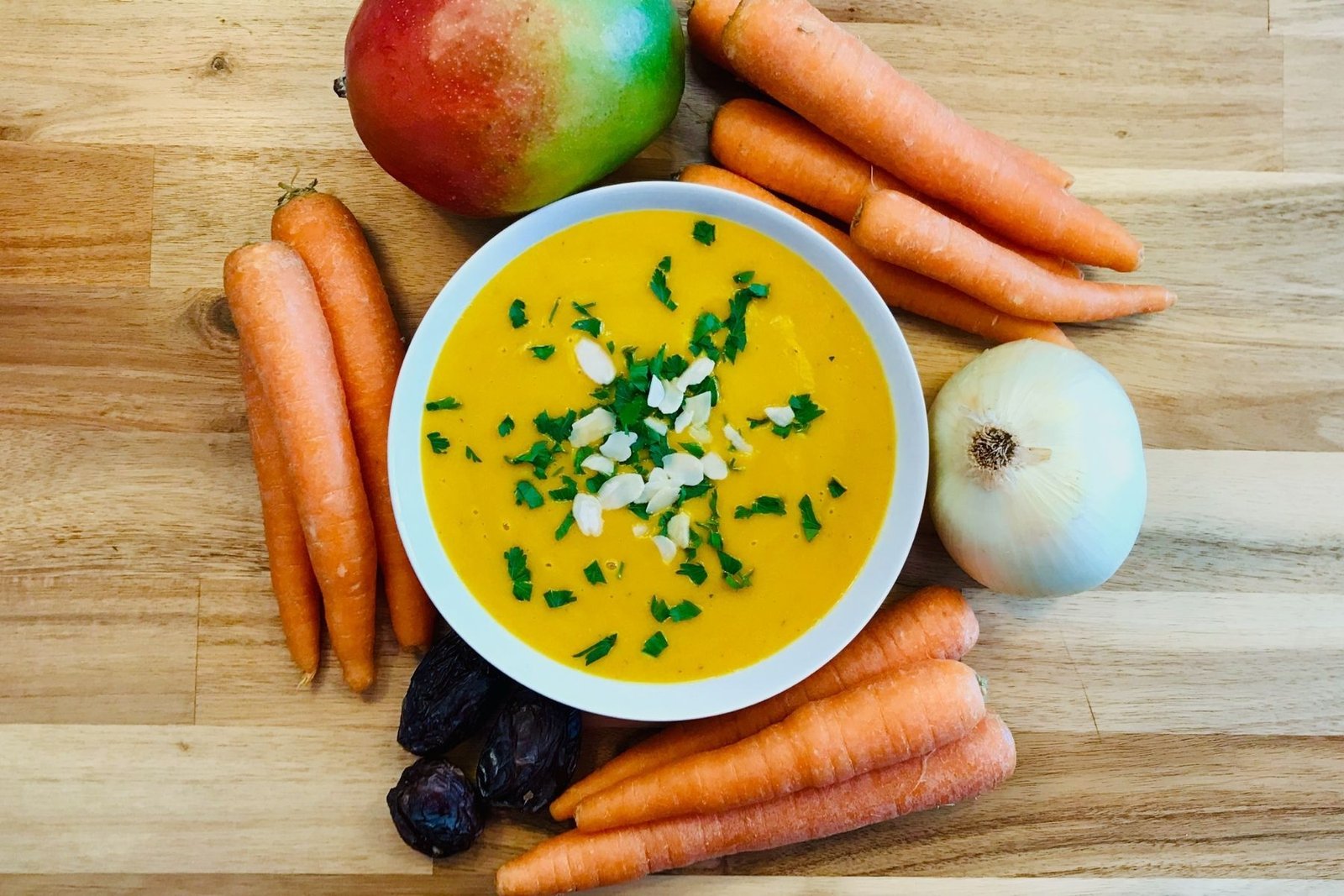
Why this soup is more than just a recipe
Acne is not caused by a single food. It develops through an interplay between your gut, hormones, inflammation, and your body’s individual responses.
This is exactly where this soup comes in. It provides nutrients your body needs for skin regeneration, while at the same time easing digestion and avoiding stimuli that can intensify inflammatory processes.
Carrots: The foundation for cell regeneration
Carrots provide beta-carotene, a precursor of vitamin A. This vitamin plays a central role in your skin because it directly influences the regulation of cell renewal.
Your body converts beta-carotene into vitamin A and uses it to control the formation of new skin cells. This process determines how quickly your skin renews itself and how evenly it is structured.
At the same time, carrots contain antioxidants. These substances neutralize free radicals that arise during inflammation and can damage skin structures.
An often underestimated factor is their fiber content. It is fermented by bacteria in your gut and supports a stable gut environment—a key factor for calm skin.
Mango: Antioxidant protection and collagen formation
Mango provides vitamin C, polyphenols, and also beta-carotene. Vitamin C in particular is essential for your skin structure.
Your body needs vitamin C to produce collagen. Collagen is the structural protein of your skin. Without sufficient vitamin C, your body cannot build these fibers in a stable way.
In addition, vitamin C acts as an antioxidant and reduces oxidative stress in your skin cells. Polyphenols from mango enhance this effect by modulating inflammatory processes at the cellular level.
The combination of carrot and mango therefore connects two mechanisms: cell renewal and protection against cellular damage.
Onion: Support for detoxification and the gut
The white onion provides sulfur-containing compounds. These substances play a role in your body’s internal detoxification processes.
Your body is constantly working to break down metabolic byproducts. If these processes are disrupted, this can indirectly affect your skin.
Onions also provide prebiotic fiber. This serves as food for your gut bacteria and promotes a stable microbial balance.
Date: Gentle sweetness without a strong reaction
The date adds a light sweetness to the soup without strongly impacting blood sugar levels.
This is relevant because strong blood sugar fluctuations can influence hormonal processes. Insulin directly affects signaling pathways associated with sebum production and inflammation.
Through the combination of natural sweetness and fiber, your body’s response remains significantly more stable.
Coconut milk: Fats for the skin barrier
Coconut milk provides saturated fatty acids that your body uses, among other things, to build cell membranes.
Your skin depends on a stable lipid barrier. If this barrier is disrupted, it loses moisture more quickly and becomes more sensitive to external stimuli.
Fats from coconut milk help stabilize this barrier while also improving the absorption of fat-soluble vitamins such as vitamin A.
Mild spices: Less irritation, more balance
The spices used—broth seasoning and an Ayurvedic spice blend—are intentionally mild.
Strongly irritating spices can intensify inflammatory reactions in sensitive individuals. Mild spices, on the other hand, support digestion without creating additional stress for your body.
This is particularly relevant if your skin already tends toward inflammation.
Alkaline and light: Why this supports your skin
This soup is alkaline-forming and easy to digest. This means your body needs to invest less energy in digestion.
When your digestion is supported, your body can allocate resources differently—among other things, toward regeneration and repair processes.
At the same time, such a meal reduces the likelihood of digestive issues that can influence inflammatory processes through the gut-skin axis.
Conclusion: Skin-friendly nutrition starts with understanding connections
This soup shows how simple a skin-friendly meal can be. At the same time, it makes clear that nutrition does not act in isolation.
Your gut determines which nutrients are actually absorbed. Your hormonal system determines how your skin responds. Inflammation can amplify or dampen these processes.
This is where the real complexity begins.
If you want to understand which mechanisms are truly decisive for you—such as your gut, hormones, inflammation, or potential intolerances—and how to structure your nutrition accordingly, the E-Book offers a much deeper classification of these connections.
Carrot Soup with Mango

Equipment
- 1 Cutting board and knife
- 1 vegetable peeler
- 1 Cooking pot and spoon
- 1 blender
Ingredients
- ½ onion snow-white
- 125 g mango
- 400 g carrots
- 1 Medjool date
- 1 tbsp coconut oil native
- 750 ml water
- 100 ml coconut milk creamy
- 1 tbsp soup seasoning see basic recipe
- ½ tsp ayurvedic spice blend see basic recipe
- ¼ tsp real caraway ground
- ½ tsp salt
Topping:
- 2 tbsp parsley fresh
- 2 tbsp almonds flaked
Instructions
- Peel the ½ onion and chop finely. Peel, core and chop the 125 g mango. Wash, peel and finely dice the 400 g carrots. Cut the 1 Medjool date into small pieces.
- Heat the 1 tbsp coconut oil in a saucepan, then add the onion and sauté until translucent.
- Then add 750 ml water, 100 ml coconut milk, 1 tbsp soup seasoning, ½ tsp ayurvedic spice blend, ¼ tsp real caraway and ½ tsp salt and bring to a boil. Reduce heat and let simmer for 20 minutes.
- Meanwhile, pick and finely chop the 2 tbsp parsley.
- Puree the soup in a blender and serve in bowls. Garnish with parsley and 2 tbsp almonds and serve.


Your article helped me a lot, is there any more related content? Thanks! https://accounts.binance.com/hu/register?ref=IQY5TET4