
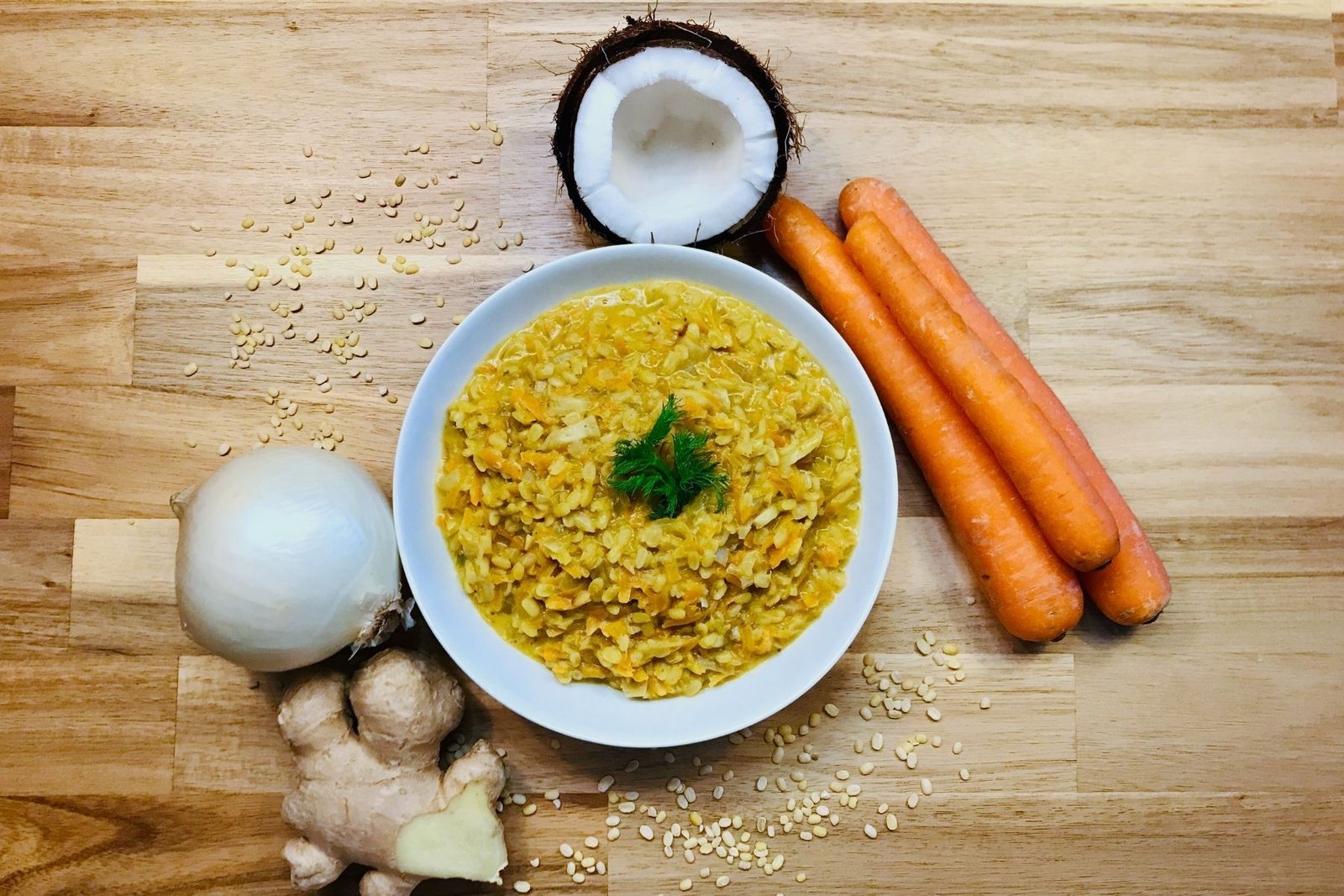
If you engage with the topic of acne nutrition, you will sooner or later encounter a central question: which meals truly relieve your body—and which do not? This is exactly where a simple dish like creamy mung dal comes in. It may seem unassuming, but it combines properties that can directly influence digestion, inflammation processes, and therefore also your skin.
Why your gut determines how your skin reacts
Your skin is not an isolated organ. It responds to processes that take place deep within your body. Your gut plays a central role in this. It determines how well you absorb nutrients, how stable your immune system functions, and how strongly inflammatory processes are activated. If your gut falls out of balance, this can affect hormonal signaling pathways, inflammation, and ultimately your skin.
This is where nutrition becomes relevant. Not in terms of individual “good” or “bad” foods, but in terms of overall interactions. A dish like mung dal is interesting because it addresses several of these levels at the same time.
Mung dal: why this legume is so unique
The basis of this dish is peeled, split mung beans. Through peeling, part of the structure that is harder to digest—common in many other legumes—is removed. This changes how your body responds to it.
Your digestive system has to perform less mechanical and enzymatic work. This means fewer fermentation processes in the gut, fewer potential irritations, and often an overall calmer digestion. This can be crucial, especially if your gut is sensitive or already under strain.
At the same time, mung beans provide plant-based protein and complex carbohydrates. This combination ensures a stable energy supply without strong blood sugar spikes. And this is relevant for your skin: fluctuations in blood sugar influence hormonal processes, particularly insulin. Persistently elevated insulin levels can intensify inflammatory processes and affect sebum production.
The creamy consistency that develops during cooking is not coincidental. Starch and soluble fiber combine into a smooth texture. This is not only pleasant in the mouth, but also in the gut: it may mechanically irritate the mucosa less than dry, difficult-to-digest foods.
Carrots: cellular protection and skin regeneration
Carrots add a second important dimension to the dish: secondary plant compounds, especially beta-carotene. Your body can convert this into vitamin A, which plays a central role in skin regeneration.
Vitamin A is involved, among other things, in how your skin cells renew themselves. If this process does not function optimally, disorders of keratinization can occur—a factor that plays a role in acne.
At the same time, carrots provide fiber. This is fermented by bacteria in the large intestine. In the process, short-chain fatty acids are produced, which can support your gut lining and exert anti-inflammatory effects. This is a direct mechanism through which nutrition affects your skin: less inflammation in the gut can mean less systemic inflammation.
Coconut milk: fat as a transport and regulatory factor
Coconut milk changes this dish on two levels. First, it makes it creamy and more energy-dense. Second, it provides fatty acids that improve the absorption of fat-soluble vitamins.
This is crucial for the carrots. Without fat, your body can utilize beta-carotene far less efficiently. Only in combination with coconut milk does this become a functional nutrient process.
In addition, fats influence hormonal signaling pathways. Your body needs certain fatty acids to produce and regulate hormones. A diet that is too low in fat can disrupt these processes, while a balanced fat intake can have a stabilizing effect.
Subjectively, coconut milk is often perceived as “soothing” or “balancing.” This can partly be explained by the way it rounds out the dish energetically and buffers strong blood sugar fluctuations.
Onion and ginger: influence on the gut and inflammation
The white, mild onion brings an interesting combination. It contains prebiotic fibers that serve as food for certain gut bacteria. These bacteria, in turn, produce metabolic byproducts that strengthen your gut barrier.
A stable gut barrier is essential. If it becomes more permeable, components from the gut can enter the body and activate the immune system. This can intensify inflammatory processes that may also manifest in the skin.
The choice of a mild, slightly sweet onion is not accidental. It is often better tolerated and—depending on your individual situation—may also play a role in cases of sensitive skin or histamine-related issues.
Ginger complements the dish with its bioactive pungent compounds. These are associated in studies with inflammation-modulating effects. This does not mean that ginger is “anti-inflammatory” in a simplistic sense, but it can influence signaling pathways involved in inflammatory processes.
Does this dish support “detoxification”?
The concept of detoxification is often misunderstood. Your body continuously detoxifies via the liver, gut, kidneys, and skin. No single food performs this function.
What nutrition can influence, however, are the underlying conditions. An easily digestible meal reduces the burden on your digestive system. Fiber supports excretion. Nutrients supply the systems involved in these processes.
In this sense, a dish like mung dal can support your body in functioning efficiently—not by “detoxifying,” but by interfering less with these processes.
Why simple meals are often underestimated
Many people look for complex strategies when it comes to acne nutrition. Yet it is often simple, well-tolerated meals that make the biggest difference in the long term.
A stew like this mung dal is easy to prepare, easy to digest, and integrates well into daily life. That is what matters. Your body does not respond to individual meals, but to patterns that repeat over weeks and months.
If you regularly provide your gut with food that is easy to digest and delivers nutrients, you change the environment over time. And this environment, in turn, influences inflammation, hormonal balance, and skin processes.
What this dish shows—and what is still missing
Creamy mung dal is a good example of how nutrition works on multiple levels simultaneously: digestion, nutrient absorption, blood sugar, inflammatory processes, and the gut environment all interact.
At the same time, a limitation becomes clear here. No single dish can explain why your skin reacts the way it does. Acne does not arise from a single cause, but from an interplay of gut health, hormones, inflammation, stress, and individual intolerances.
This is exactly where it becomes interesting. If you want to understand which of these mechanisms are truly decisive for you, how to structure your nutrition, and which common mistakes many people make, you need a deeper understanding. The E-book breaks down these connections in detail—not as rigid rules, but as a system you can apply to your own body.
Creamy Mung Dal with Carrots

Equipment
- 1 Cutting board and knife
- 1 Vegetable grater
- 1 vegetable peeler
- 1 Cooking pot and spoon
Ingredients
- 2 onions snow-white
- 20 g ginger fresh
- 600 g carrots
- 2 tbsp coconut oil native
- 1 tsp real caraway ground
- 2 tsp salt
- 4 tsp ayurvedic spice blend see basic recipe
- 320 g mung beans peeled and halved
- 500 ml coconut milk creamy
- 500 ml water
Instructions
- Peel the 2 onions and finely dice them. Peel and finely grate the 20 g ginger. Roughly grate the 600 g carrots with a vegetable grater.
- Heat 2 tbsp coconut oil oil in a large saucepan and sauté onions, ginger and 1 tsp real caraway, 2 tsp salt and 4 tsp ayurvedic spice blend.
- Rinse 320 g mung beans under running water until runoff water runs clear.
- Add the mung beans and grated carrots to the saucepan with the onions and spices. Add 500 ml coconut milk and 500 ml water.
- Simmer on a low heat for 30 minutes until the dish has a creamy consistency. However, the mung beans should not completely disintegrate.


Can you be more specific about the content of your article? After reading it, I still have some doubts. Hope you can help me. https://www.binance.com/register?ref=JW3W4Y3A