
Fresh sprouts may seem unremarkable, but at a cellular level, germination is a highly active process. Mung bean sprouts in particular are among the most interesting foods when you focus on skin-friendly nutrition. They not only provide nutrients but actively change how your body can utilize them.
What Really Happens During Germination
When you soak mung beans and allow them to sprout, you activate enzymatic processes that were inactive in the dry seed. Enzymes begin to break down complex storage compounds such as starch and proteins. From structures that are difficult to digest, smaller building blocks are formed that your gut can absorb much more easily.
At the same time, the nutrient composition changes. Certain vitamins, especially vitamin C and some B vitamins, are newly formed during germination. At the same time, the content of so-called antinutrients decreases, which would otherwise bind minerals. The result is not a “new” food, but a more bioavailable version of the same one.
This change is crucial: it is not just about what you eat, but how well your body can actually use it.
Why Sprouts Influence Your Gut
Mung bean sprouts contain fiber in a form that is particularly interesting for your gut microbiome. These fibers serve as a substrate for gut bacteria. During their metabolism, short-chain fatty acids are produced, which play a central role for your intestinal lining.
These fatty acids stabilize the gut barrier and have inflammation-modulating effects. This is exactly where the connection to your skin arises. Your gut plays a key role in determining how well nutrients are absorbed and how strongly inflammatory processes occur in your body. A disturbed gut environment can affect both nutrient supply and hormonal processes.
If your gut is not functioning optimally, even high-quality foods cannot fully unfold their effects. Sprouts target this point by supporting digestion while simultaneously nourishing the microbiome.
Nutrients and Their Role for Your Skin
Mung bean sprouts provide plant-based protein, micronutrients, and secondary plant compounds. These do not act in isolation but interact with each other. Antioxidative compounds can reduce oxidative stress, which plays a role in inflammatory skin processes. At the same time, certain micronutrients support cell division and thus the regeneration of your skin.
However, the interaction is what matters: nutrients influence your immune system, your immune system influences inflammation, and inflammation directly affects your skin. This chain is often presented in a simplified way, but in reality, it is a finely tuned system.
That is why the focus is not on isolating individual “superfoods,” but on understanding how foods function within this network.
Blood Sugar, Insulin, and Hormonal Connections
Legumes such as mung beans generally have a stabilizing effect on your blood sugar levels. Through germination, this effect can become even more pronounced because the carbohydrates they contain are partially pre-digested and absorbed more evenly.
Stable blood sugar means fewer pronounced insulin spikes. This is relevant because insulin influences hormonal processes that can, in turn, be linked to sebum production and inflammation. Strong fluctuations in blood sugar tend to amplify these processes.
This does not mean that individual foods “cause” or “cure” acne. However, they can create conditions that either promote or reduce certain processes.
Raw or Cooked – What Makes Sense?
You can eat mung bean sprouts both raw and heated. Raw, they retain maximum enzymatic activity and heat-sensitive vitamins. At the same time, raw sprouts require careful preparation because they are a sensitive food.
If you are sensitive or your digestion becomes easily overwhelmed, light steaming can be beneficial. This reduces potential microbes and makes the sprouts easier to digest. The enzymatic advantage is then lower, but tolerance improves.
This illustrates an important principle: there is no single correct approach. What matters is how your body responds.
Versatile Use in Everyday Life
Mung bean sprouts are among the most versatile foods you can use in your kitchen. You can enjoy them raw in salads, add them to bowls, or use them as a fresh topping. In warm dishes such as stews or stir-fries, they also work well when briefly cooked.
They can be processed into spreads or incorporated into doughs. Even in bread, they can be used to influence not only the nutrient composition but also the texture.
This versatility is not accidental. It makes it easier to include a nutrient-dense food in your routine without it becoming monotonous.
Transferability to Other Sprouts
The principle of germination can also be applied to other foods such as lentils or quinoa. Here too, enzymes are activated, nutrients become more available, and digestibility improves.
The exact nutrient composition varies, but the underlying mechanism remains the same. You are not only changing the food itself, but also how your body responds to it.
What You Can Actually Take Away
Mung bean sprouts are not an isolated miracle solution. They are an example of how strongly the processing of a food can change its effects. Germination creates new enzymatic activity, improves nutrient availability, and changes the interaction with your gut.
At the same time, this example shows how closely nutrition, gut health, hormones, and inflammation are interconnected. Your skin does not result from a single factor, but from a complex network of processes.
This is where the key question arises: which of these mechanisms play a role for you personally? And how can you structure your nutrition so that it addresses exactly those areas? The e-book explains in detail how gut health, hormones, inflammation, and individual intolerances interact, which common mistakes many people make, and how you can gradually develop a way of eating that fits your body.
Fresh Sprouts

Equipment
- 1 glass jar and sieve
- 1 sprouting jar (optional)
- 1 tea towel
Ingredients
Seed material depending on what you want to germinate:
- mung beans organic, whole and dried
- lentils organic, whole and dried
- quinoa organic, whole and dried
Instructions
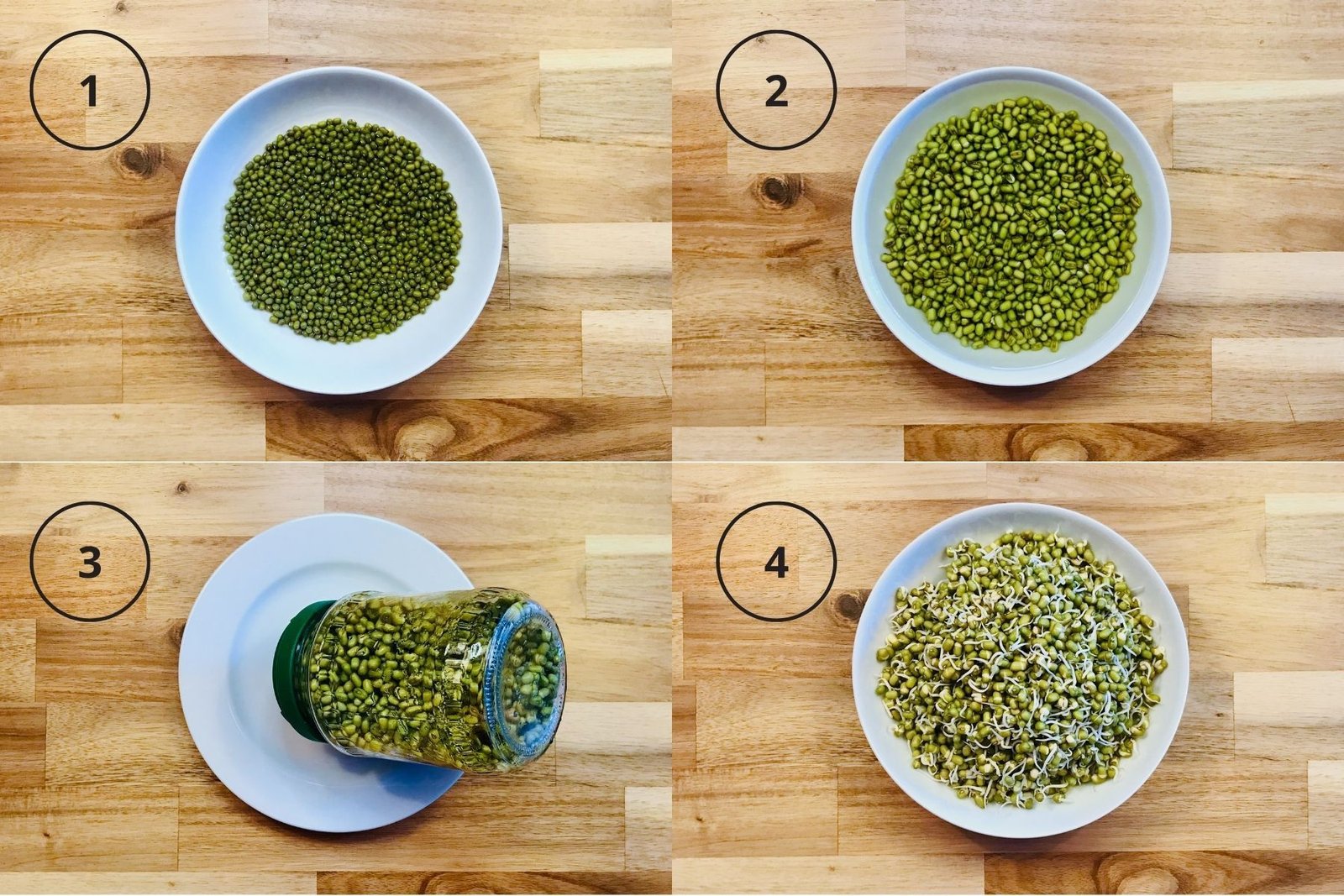
- Soak the seeds in water. See soaking times for each seed in the recipe notes.
- Pour off the water using a sieve.
- Pour the seedlings into a glass and set aside in a warm place.
- Place dark germs in a dark place and cover with a kitchen towel. Place the light germinator on the window sill. Read which seeds are dark and light germs in the recipe notes.
- Rinse with fresh water and drain every 4-8 hours. In summer, the germination process takes less time due to the higher outside temperature and the seedlings should be rinsed more often. See estimated germination times for each seed in the recipe notes.
- As soon as small germs have formed, the seedlings should be stored in the refrigerator until further processing, as the seedlings become bitter if they germinate too much.
Notes
The seed material used should always be natural, unpeeled and of organic quality, otherwise it will not germinate.
Mung beans:
-
Soaking time: 8 hours
-
Dark germs
-
Germination time: 2 days
Lentils:
-
Soaking time: 8 hours
-
Dark germs
-
Germination time: 3 days
Quinoa:
-
Soaking time: 4 hours
-
Light germinator
-
Germination time: 1 day


Thank you for your sharing. I am worried that I lack creative ideas. It is your article that makes me full of hope. Thank you. But, I have a question, can you help me?
Thank you for your sharing. I am worried that I lack creative ideas. It is your article that makes me full of hope. Thank you. But, I have a question, can you help me?
Thanks for sharing. I read many of your blog posts, cool, your blog is very good.