
If you want to truly understand your skin, it is worth looking at what ends up on your plate every day. A skin-friendly diet does not begin with individual “superfoods,” but with meals your body can process efficiently.
This broccoli soup is built exactly that way. It combines a few carefully selected ingredients that do not overwhelm your metabolism, but help stabilize it. This creates a foundation on which processes in your gut, your immune system, and ultimately your skin can shift.
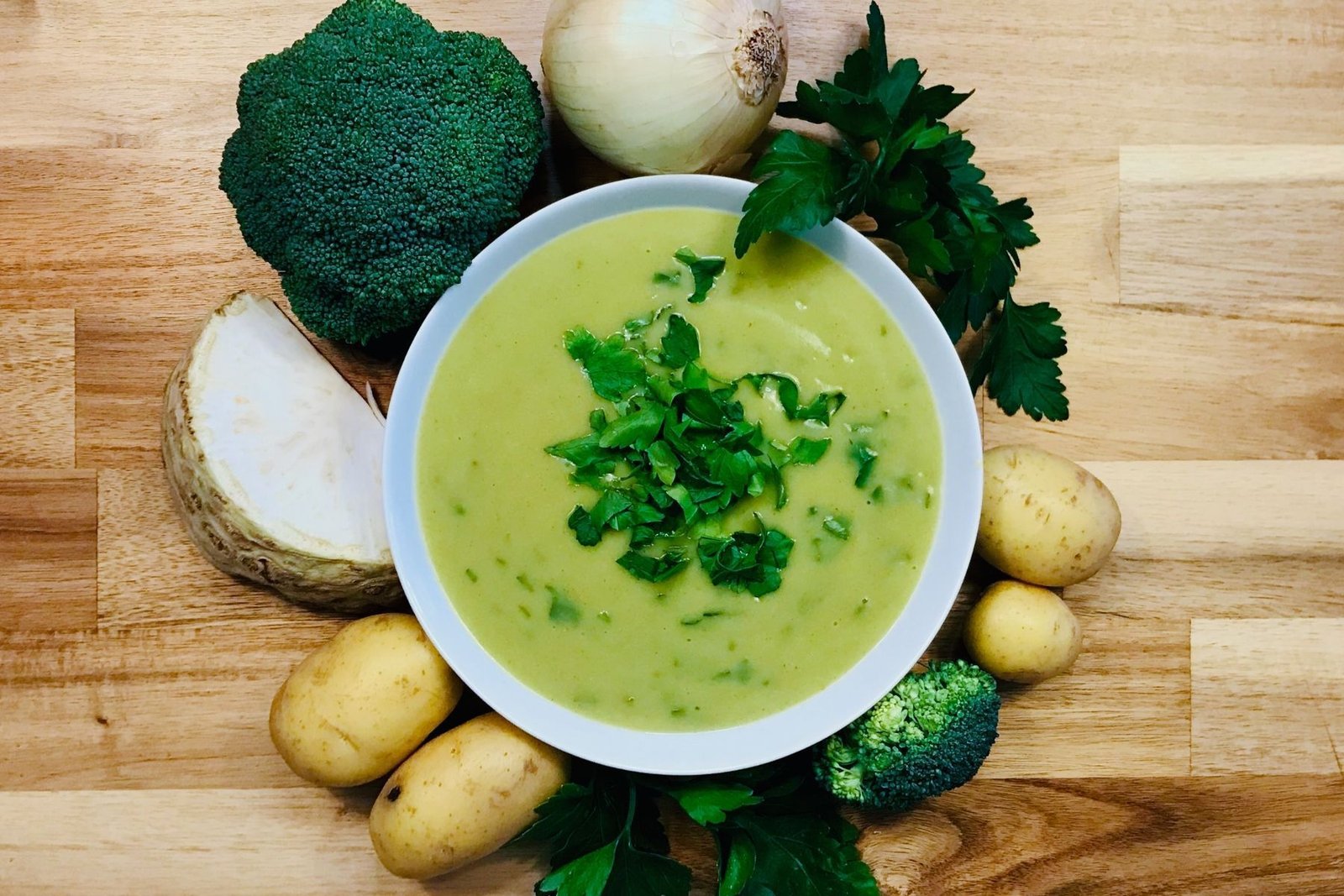
Why broccoli plays a special role in acne
Broccoli belongs to the cruciferous vegetables and provides a high density of micronutrients and secondary plant compounds. Particularly relevant are compounds such as glucosinolates, from which bioactive substances are formed in your body that are involved in detoxification processes. At the same time, broccoli contains vitamin C, precursors of vitamin A, and various minerals.
These substances do not act directly on your skin. They act through your metabolism. Your body uses them to regulate oxidative stress, influence inflammation, and stabilize cellular functions. These are precisely the processes that are often altered in acne.
Preparation also plays a decisive role. Cooked broccoli is significantly more accessible to your gut than raw forms. This reduces potential irritation and improves the availability of the nutrients it contains.
Cruciferous vegetables, detoxification, and your metabolism
Cruciferous vegetables such as broccoli influence enzyme systems in your liver. These enzymes regulate how your body processes and eliminates metabolic byproducts. When these processes function efficiently, the likelihood that intermediate products accumulate in your body and promote inflammation decreases.
For your skin, this does not mean that broccoli “detoxifies.” It means that your body is better able to regulate its own processes. And this regulation is exactly what matters when it comes to chronic skin issues.
Potatoes and the gut microbiome: underestimated for the skin
At first glance, potatoes seem unspectacular, but they play a central role in this soup. They provide easily available energy and at the same time resistant starch, which serves as a food source for your gut bacteria.
Your gut microbiome processes this starch into short-chain fatty acids. These substances nourish your intestinal lining, stabilize the barrier function, and influence inflammatory signaling pathways.
If these processes are disrupted, your intestinal barrier can become more permeable. As a result, more substances enter your body that activate your immune system. This activation often does not show up in the gut itself, but on your skin.
In this context, potatoes do not act directly on acne. They create conditions under which your gut can function more stably.
Celery and minerals: regulation instead of irritation
Celeriac complements the soup with minerals such as potassium and secondary plant compounds. These support, among other things, fluid balance and enzymatic processes.
At the same time, celery adds a mild, natural flavor. This reduces the need for heavily processed ingredients, which often contain additives and can trigger reactions in sensitive individuals.
Especially for sensitive skin, this reduction is crucial. Not because individual substances are inherently problematic, but because your system has to process fewer factors at once.
Seasoning and onion: underestimated influencing factors
The seasoning used in the soup and the onion provide additional plant compounds that can affect your microbiome. Onions contain prebiotic fibers that selectively support certain bacteria.
These bacteria are involved in the production of short-chain fatty acids, which in turn influence inflammatory processes in your body.
This creates a connection that is often underestimated: it is not individual foods that change your skin, but the sum of microbial processes in your gut.
Alkaline-forming nutrition and skin: what it actually means
This broccoli soup is structured as an alkaline-forming meal. This does not mean that your body needs to be “deacidified.” Your blood pH is tightly regulated.
Rather, it means that you provide your body with foods rich in minerals that create less metabolic burden. A high acid load from highly processed foods, sugar, or certain protein sources can intensify processes in your body that are already dysregulated.
A plant-based diet has a balancing effect here. It provides fiber, antioxidants, and micronutrients without creating additional strain.
Why this soup is particularly well tolerated
The combination of cooked vegetables, few ingredients, and fresh preparation makes this soup well tolerated for many people. It contains no typical irritants and is based on foods that often work well even with sensitive digestion.
This can be particularly relevant if you suspect intolerances or have sensitive skin. Every additional irritation in your gut can amplify inflammatory processes that later become visible on your skin.
At the same time, an important point becomes clear here: tolerance is individual. Not every food affects every person in the same way. This is exactly why it makes sense to work with simple, clear meals and observe your reactions.
Gut, hormones, and inflammation: the actual connection to your skin
Your gut does not only influence digestion. It is closely connected to your immune system and your hormonal balance. Changes in the microbiome can modulate hormonal processes, amplify or reduce inflammatory responses, and affect nutrient absorption.
When your gut becomes imbalanced, several effects often occur simultaneously. Nutrients are absorbed less efficiently, inflammatory signaling remains active, and hormonal regulation shifts. This combination can contribute to the development of acne.
A meal like this broccoli soup does not act on just one of these processes in isolation. It works through the system.
Conclusion: why simple recipes often have more impact than complex strategies
This broccoli soup is not a specific “acne recipe.” It shows how a meal can be structured in a way that supports your body instead of placing additional strain on it.
This is where its value lies. Not in individual ingredients, but in the combination of tolerance, nutrient density, and metabolic relief.
At the same time, it becomes clear how complex the topic of acne nutrition is. Gut, hormones, inflammation, and individual intolerances interact and cannot be reduced to single foods. The E-Book explains in detail which mechanisms are truly decisive, how to structure and individualize your nutrition, and which common mistakes many people make.
Broccoli Soup

Equipment
- 1 Cutting board and knife
- 1 vegetable peeler
- 1 Cooking pot and spoon
- 1 blender
Ingredients
- ½ onion snow-white
- 350 g broccoli
- 100 g celeriac
- 200 g potato
- 1 tbsp coconut oil native
- 1 liter water
- 2 tbsp soup seasoning see basic recipe
- 1 tsp salt
- 25 g parsley fresh
Instructions
- Peel and dice the ½ onion. Wash, trim and roughly chop the 350 g broccoli. Clean and roughly chop the 100 g celeriac. Peel and coarsely chop the 200 g potato.
- Heat the 1 tbsp coconut oil in a saucepan and sauté the onions in it until translucent.
- Add the broccoli, celeriac and potatoes and sauté briefly.
- Pour in the 1 liter water, add the 2 tbsp soup seasoning and 1 tsp salt.
- Bring to the boil, then reduce the heat and simmer for 20 minutes, until the vegetables are tender.
- In the meantime, wash, pluck and finely chop the 25 g parsley.
- After the cooking time, puree the soup in a blender, fold in the parsley, fill into small bowls and serve!


Your point of view caught my eye and was very interesting. Thanks. I have a question for you.
Thanks for sharing. I read many of your blog posts, cool, your blog is very good.