
A skin-friendly juice is more than just a trend. It can be a targeted tool to provide your body with nutrients in a form that is quickly available and supports specific processes. This is exactly where carrot beet juice comes in.
The combination of carrots, raw beetroot, and flaxseed oil does not act in isolation. It interacts with a complex system that influences your skin: digestion, nutrient absorption, inflammatory processes, and hormonal regulation.
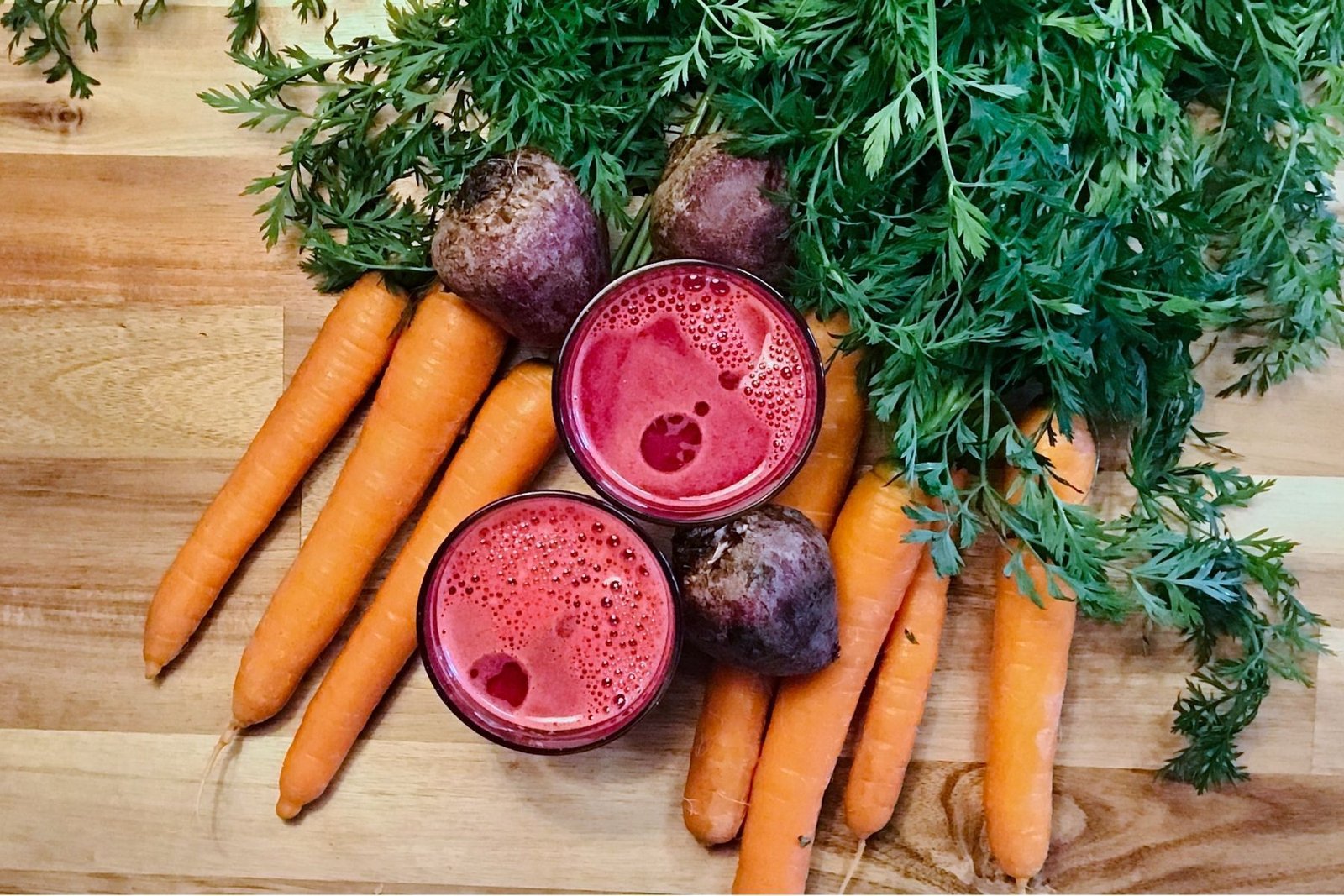
Why vegetable juices work differently than whole meals
When you juice vegetables, you mechanically reduce digestive effort. Your body no longer has to break down cell structures as extensively. The micronutrients they contain become available more quickly. This does not mean that juices are “better” than solid food. It means they work differently.
Especially when your gut is under strain or nutrients are absorbed less efficiently, this form of intake can play a role. Your small intestine is the central site of nutrient absorption. If processes there are disrupted, even high-quality foods cannot fully unfold their effects.
A juice therefore changes not only what you take in, but also how your body can work with it.
Carrots: precursors for skin regeneration
Carrots provide large amounts of beta-carotene. Your body converts this compound into vitamin A, which plays a central role in skin renewal. Skin cells are among the fastest-renewing tissues. Without adequate supply, this process slows down.
At the same time, beta-carotene has antioxidant effects. It protects cells from oxidative stress caused by environmental factors, UV radiation, and inflammatory processes. This type of stress is associated with skin aging and inflammatory skin conditions.
However, it is not only intake that matters, but also utilization. Beta-carotene is fat-soluble. Without fat, part of it remains inaccessible to your body.
Flaxseed oil: the underestimated key to absorption
This is where flaxseed oil comes into play. It provides essential fatty acids, particularly alpha-linolenic acid, and at the same time enables the absorption of fat-soluble vitamins.
This changes the effect of the entire juice. Without fat, beta-carotene remains partially unused. With fat, it becomes bioavailable. Your body can absorb it, convert it, and use it for cellular processes.
In addition, omega-3 fatty acids have inflammation-modulating effects. Inflammation plays a central role in acne. It does not arise only locally in the skin, but often systemically in the body.
Beetroot: cellular protection and circulation
Beetroot provides a different class of secondary plant compounds. The betalaine pigments it contains have strong antioxidant effects and protect cells from oxidative stress. At the same time, it contains betaine, which stabilizes cell structure and can support skin hydration.
Beyond that, beetroot influences circulation. Improved microcirculation means that nutrients reach your skin more efficiently. At the same time, metabolic byproducts are transported away more quickly.
Beetroot also provides folate and iron. Both are essential for cell division and oxygen transport. Without these processes, your skin cannot regenerate optimally.
Antioxidants and skin: what actually lies behind it
Antioxidants are often presented in a simplified way. They “neutralize free radicals.” That is true, but it does not go far enough.
Free radicals are constantly produced in your body, for example through metabolic processes or stress. It becomes problematic when an imbalance occurs. This is referred to as oxidative stress.
This stress influences inflammatory signaling pathways. These are exactly the processes involved in acne. Antioxidants do not act directly on the skin, but on the underlying mechanisms.
Carrot beet juice provides several antioxidants at once. These do not act in isolation, but in combination. That is crucial.
Gut, inflammation, and skin – the actual connection
Your skin is not an isolated organ. It responds to processes that take place inside your body.
The gut plays a central role in this. It determines which nutrients are absorbed and how your immune system responds. If balance in the gut is disrupted, inflammatory processes can arise that also affect your skin.
Hormonal processes are also linked to this. Certain gut bacteria influence how hormones are processed and excreted. Changes in the microbiome can therefore indirectly affect your skin.
A nutrient-rich juice can support this, but it does not replace a holistic perspective. It is one component, not a system.
Why this juice is strategically meaningful
The combination of carrots, beetroot, and flaxseed oil is not random. It connects multiple mechanisms:
You supply your body with antioxidant plant compounds. At the same time, flaxseed oil improves the absorption of fat-soluble vitamins. The liquid form reduces digestive effort and increases nutrient availability.
The result is not a “detox” or a short-term solution. It is targeted support for specific processes that are relevant to your skin in the long term.
This is exactly what distinguishes a random juice from a functional approach.
Conclusion: one component – but not the solution
Carrot beet juice can support your skin because it addresses multiple levels at once: nutrient supply, antioxidant processes, and inflammatory mechanisms.
However, skin problems rarely arise from a single factor. Nutrition, gut, hormones, and individual intolerances interact. This is precisely why it is not enough to look at individual foods in isolation.
If you want to truly understand which mechanisms play a role for you and how to structure your nutrition accordingly, it becomes more complex. This is exactly where the e-book comes in. It is not just about individual recipes, but about the underlying connections – and why many approaches do not work in the long term.
Carrot Beetroot Juice

Equipment
- 1 vegetable peeler
- 1 Cutting board and knife
- 1 juicer (if possible a slow juicer)
Ingredients
- 1.5 kg carrots
- 300 g beetroot raw
- 2 tsp linseed oil
Instructions
- Peel the carrots and beetroot, cut into small pieces and juice.
- Add a dash of linseed oil and stir.


Your article helped me a lot, is there any more related content? Thanks!
Can you be more specific about the content of your article? After reading it, I still have some doubts. Hope you can help me.
Your article helped me a lot, is there any more related content? Thanks! https://www.binance.info/register?ref=IHJUI7TF