
A green breakfast juice affects your body differently than solid food. Not better, not worse – just different. While solid meals require digestive work, the nutrients in a juice are already in a form that your body can absorb more quickly. That is the key difference: less mechanical processing, less enzymatic breakdown, more direct access to micronutrients.
This does not mean that a juice replaces a balanced diet. But it can influence certain processes in your body in a way that is particularly relevant in the morning: when your digestive system is not yet fully active and your metabolism is just starting the day.
The effect does not arise from an abstract concept like “detox,” but from the specific properties of the ingredients themselves.
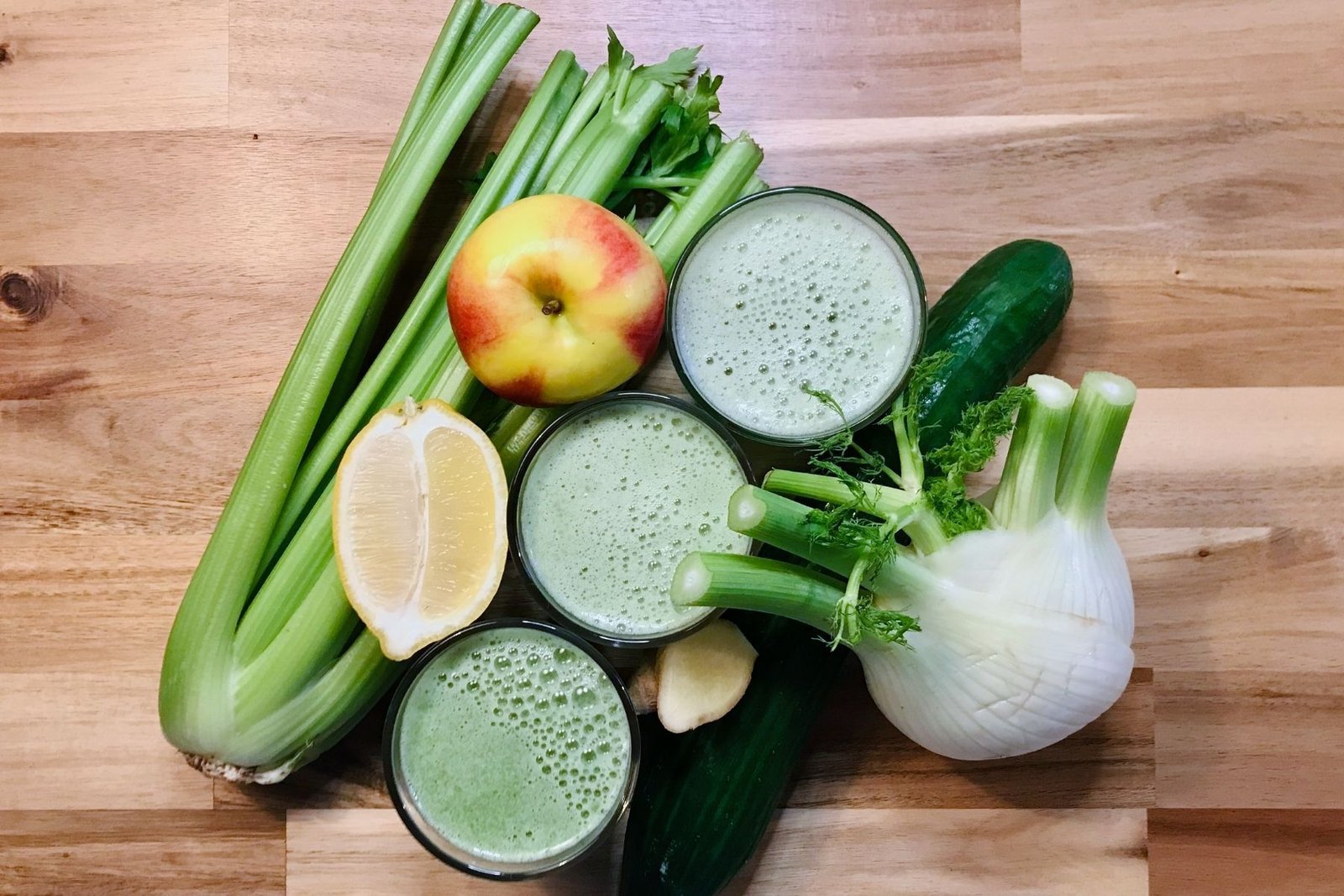
What happens in your body: the ingredients as functional building blocks
Fennel and celery provide not only water, but also electrolytes and secondary plant compounds. This combination affects your digestive system because it influences the conditions in your gut. Electrolytes regulate fluid balance, while plant compounds interact with bacterial activity in your gut. They do not directly change your skin, but they engage in processes that may be relevant over time.
Cucumber consists largely of water, but not in isolation—rather, it is embedded within a plant structure. This structure contains micronutrients that help regulate absorption in your body. This is what distinguishes its effect from plain water. Your body does not simply absorb fluid; it processes it within the context of this matrix.
Lemon brings vitamin C and organic acids into your system. These play a role in enzymatic processes involved in many metabolic reactions. This is not about a direct effect on your skin, but about supporting reaction pathways that operate in the background.
Ginger influences the activity of your digestion. Its pungent compounds affect movement processes in the gastrointestinal tract and can modulate inflammation-related signaling pathways. These effects are subtle, but they change the dynamics of how your body processes food.
Apple provides mild sweetness, but what matters most is the pectin it contains. This soluble fiber fragment serves as a substrate for certain gut bacteria. From this, metabolic products are formed that can, in turn, influence your gut environment.
These relationships reflect a fundamental principle also described in the context of the gut-skin connection: processes in your gut indirectly affect other systems without a single isolated cause :contentReference[oaicite:0]{index=0}.
Nutrient availability and reduced digestive load
The liquid form changes how your body handles nutrients. Because less mechanical breakdown is required, the allocation of energy shifts. Your body needs to expend less energy on digestion, allowing resources to remain available for other processes.
At the same time, water-soluble vitamins, minerals, and plant compounds reach the small intestine more quickly, where absorption takes place. This does not mean that more is absorbed – but the speed and context of absorption change.
This shift can be indirectly relevant for systems that are sensitive to energy distribution, including processes associated with skin conditions.
Gut and microbiome: changing conditions rather than direct effects
A green juice does not act like a targeted “gut remedy.” But it does change the environment in which your microbiome operates. Soluble components such as pectin and certain plant compounds serve as substrates for bacteria, while harder-to-digest components are reduced.
This means: less strain, a different nutritional basis for microorganisms, more stable digestive processes – at least temporarily. What matters is not a single effect, but the sum of these changes.
Especially if your digestive system is sensitive, this form of nutrient intake can create a phase in which your gut is less burdened. And it is precisely this relief that can influence conditions that, in turn, are connected to skin processes.
Understanding hydration at the cellular level
Hydration is more than drinking water. What matters is how fluid is distributed and absorbed in your body. In plant-based foods, water exists within a structure that contains electrolytes and micronutrients. These influence transport mechanisms across cell membranes.
This means: fluid from food is processed differently than isolated water. It does not simply remain in the digestive tract but is integrated into a more complex metabolic context.
This difference is subtle, but relevant when it comes to supplying tissues – including your skin.
Inflammation regulation as an indirect factor
Many of the plant compounds it contains act as antioxidants or interact with inflammation-related signaling pathways. The goal is not to “stop” inflammation, but to modulate oxidative stress.
Oxidative stress constantly arises in your body. What matters is the balance between stressors and regulatory factors. A diet that regularly provides antioxidant substances can influence this balance.
Since inflammatory processes can play a role in skin changes, an indirect connection emerges here. Not as a cause-and-effect chain, but as part of a larger system.
Context: what this juice is – and what it is not
A green breakfast juice is not a miracle cure. It does not replace meal structure, a balanced diet, or individual adaptation to your body. But it can be a tool.
Especially in the morning, when your system is not yet fully active, an easily available source of nutrients can be useful. It can also have a relieving effect in cases of sensitive digestion.
At the same time, context remains crucial. Factors such as gut condition, hormonal regulation, or individual intolerances determine how your body responds.
Why does your body react differently to the same juice?
You may have experienced that a juice works well for you – or not at all. This is exactly where the complexity of the relationship between nutrition and skin becomes apparent.
Your gut, your hormonal balance, and your level of inflammation determine how your body reacts to certain foods. That is why even something generally considered “healthy” can have different effects from person to person.
This connection is explored in more depth in the E-Book: which mechanisms truly matter, how you can structure your nutrition individually, and why many approaches fall short. It is not about individual foods, but about understanding the processes behind them. That is where clarity emerges.
Green Breakfast Juice

Equipment
- 1 Cutting board and knife
- 1 juicer (if possible a slow juicer)
Ingredients
- 2 apples sweet
- 2 cucumbers
- 2 bulbs of fennel large
- 1 lemon
- 10 sticks of celery
- 20 g ginger fresh
Instructions
- Cut all ingredients into small pieces.
- Juice all the ingredients one after the other in the slowjuicer. It is a good idea to juice the watery ingredients first (apple, cucumber, lemon) and the fibrous ingredients last (ginger, celery, fennel).


Thank you for your sharing. I am worried that I lack creative ideas. It is your article that makes me full of hope. Thank you. But, I have a question, can you help me? https://www.binance.com/register?ref=IHJUI7TF