
Your skin is closely connected to what’s happening inside your body. In this article, you’ll learn how your gut influences how well your skin is supplied with nutrients, how inflammation develops, and what role the microbiome, hormones, and stress play in acne.
You’ll get a clear and easy-to-understand overview of these connections—and why the gut is often an underestimated factor in skin issues like acne.
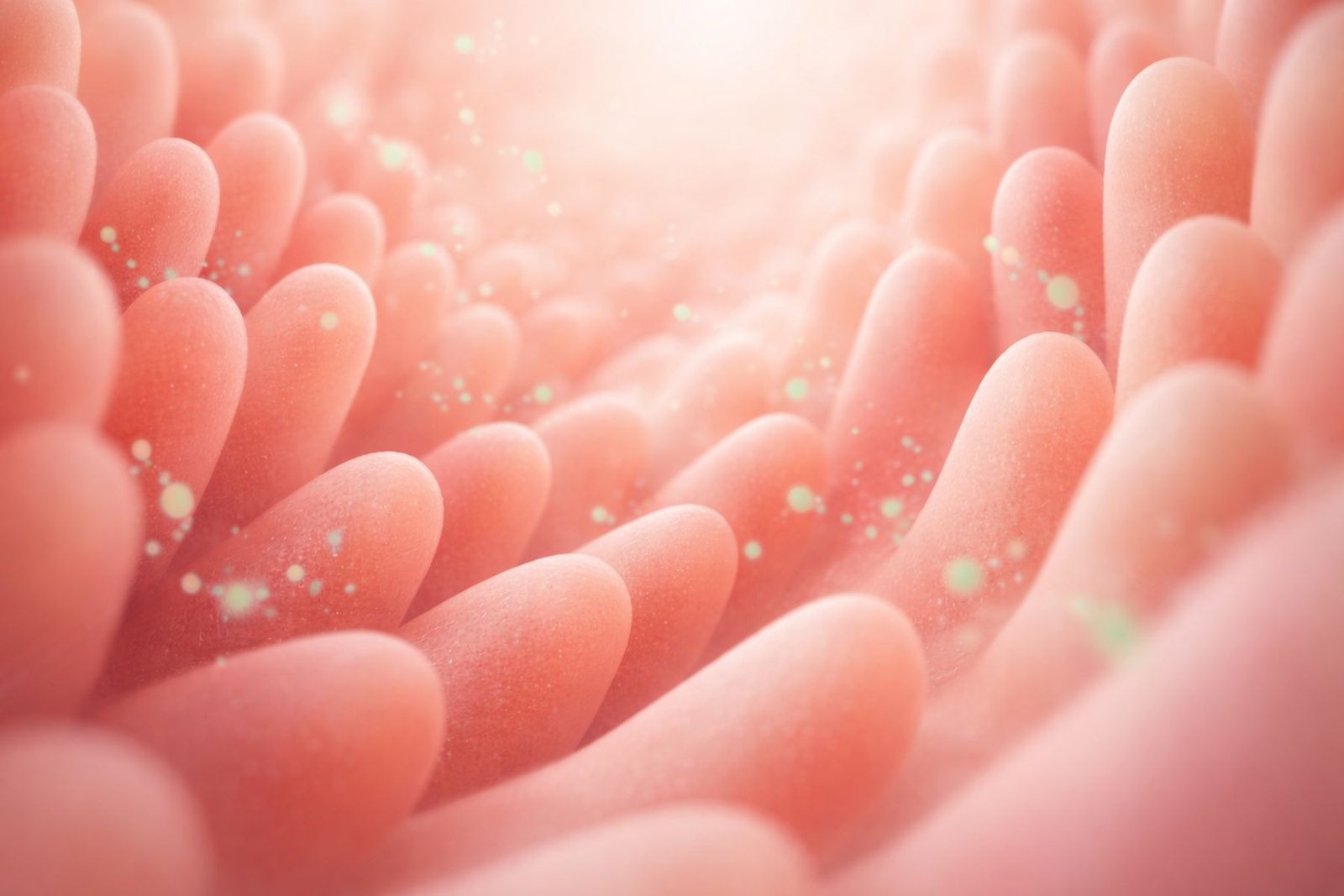
The gut determines how well your skin is supplied with nutrients
For your skin to remain healthy, it requires a continuous supply of nutrients. Vitamins, trace elements, amino acids, and fatty acids are essential for the regeneration of skin cells, for antioxidant protection, and for the regulation of inflammatory processes.
However, these nutrients do not travel directly from food into your skin. They must first be processed in the digestive system. Only in the small intestine are they released from food and absorbed through the intestinal lining into the bloodstream.
If your digestive system functions well, your body can utilize these nutrients efficiently. But if the gut environment becomes imbalanced, nutrient absorption may also change. In some cases, deficiencies can develop even though the diet actually provides enough nutrients.
Over time, such changes can also affect the skin. If certain antioxidants are lacking, for example, susceptibility to oxidative stress increases. This process can intensify inflammation and accelerate skin aging. Trace elements such as zinc also play an important role in inflammatory skin processes.
The condition of your gut therefore indirectly determines whether your skin receives the building blocks it needs for stability and regeneration.
The gut microbiome – a complex ecosystem
Trillions of microorganisms live in the gut. This community of bacteria, fungi, and other microbes is referred to as the gut microbiome. Together, they form a complex ecosystem that performs numerous tasks in the body.
Many of these microorganisms support digestion. They break down dietary fiber, produce short-chain fatty acids, and even synthesize certain vitamins. At the same time, they influence immune responses and help stabilize the intestinal barrier.
A high diversity of different bacterial species is considered a sign of a stable gut environment. When this balance shifts, experts refer to the condition as dysbiosis. During dysbiosis, metabolic processes in the gut can change and inflammatory signaling pathways may become more active.
Such changes do not affect the digestive system alone. Other organs can also respond to them – including the skin.
Gut bacteria influence hormonal processes
The gut microbiome also plays a role in hormone metabolism. Certain gut bacteria produce enzymes that determine whether hormones are reabsorbed in the intestine or excreted from the body.
A well-known example is estrogen metabolism. Gut bacteria can influence how much estrogen circulates in the body. If the composition of the gut flora changes, this hormonal pathway may shift as well.
Since hormonal fluctuations play an important role in acne, this connection is particularly interesting. Changes in the gut flora do not automatically cause hormonal acne. However, they can create conditions that intensify hormonal imbalances.
Another important factor is stress.
During prolonged stress, the body releases higher levels of the stress hormone cortisol. Cortisol not only affects the nervous system but also influences the composition of the gut microbiome. At the same time, it can weaken the intestinal barrier and promote inflammatory processes.
This creates a feedback loop: stress alters the gut, and changes in the gut can in turn amplify stress responses.
The intestinal barrier protects your body
The intestinal lining forms an important protective layer between the contents of the gut and the bloodstream. It ensures that nutrients are absorbed while unwanted substances remain inside the digestive tract.
If this barrier becomes weakened, it may become more permeable. In scientific literature, this condition is referred to as increased intestinal permeability. In everyday language, it is often described as “leaky gut.”
When the intestinal barrier no longer fully performs its protective function, bacterial components or food antigens can more easily enter the body. The immune system responds to this with inflammatory reactions.
Such chronic low-grade inflammation can affect various organ systems. Inflammatory skin processes can also become more pronounced as a result.
The gut, stress, and skin are closely connected
The gut constantly communicates with the brain. This connection is known as the gut–brain axis. Nerve pathways, hormones, and immune signaling molecules transmit signals between the digestive system and the nervous system.
Stress can therefore have a direct influence on your gut environment. It can change intestinal motility, alter the composition of gut bacteria, and weaken the intestinal barrier.
At the same time, changes in the microbiome can feed back into the body’s stress response. Some gut bacteria produce metabolic compounds that influence the nervous system and can affect how the body responds to stress.
These interactions demonstrate how closely the gut, the nervous system, and the skin are connected.
The gut is an important contributor – but not the only cause
Acne rarely develops due to a single factor. In most cases, several influences interact. Hormones, genetic factors, nutrition, stress, immune responses, and lifestyle all play a role at the same time.
The gut is therefore an important contributor, but not the sole cause.
Its influence becomes evident in the way it regulates fundamental processes in the body. The gut helps determine how effectively nutrients are absorbed, how actively the immune system responds, and how stable hormonal regulation remains.
When this system becomes imbalanced, conditions can develop that promote inflammatory skin processes.
Why it is worth taking a closer look at the gut
The gut affects far more than digestion alone. It influences immune responses, metabolic processes, hormonal signaling pathways, and even stress regulation. Changes in the gut can therefore have effects on several levels at the same time.
This article provides only an initial overview of these connections. The gut microbiome consists of thousands of different microorganisms that interact with one another and work together to stabilize the balance within the digestive system.
In my E-book, I explore these connections in much greater depth. Among other things, you will learn which gut bacteria are particularly important for maintaining a stable gut environment, how nutrition can influence the microbiome over the long term, and which habits can help strengthen the intestinal barrier.
If you want to understand why skin problems such as acne are often linked to internal processes, it is worth taking a closer look at this fascinating ecosystem inside the gut.


24 thoughts on “Acne and Gut Health: What’s the Real Connection?”